
NZPS Projects
Northumbria University Projects
2707/NZPS/NU/Winter
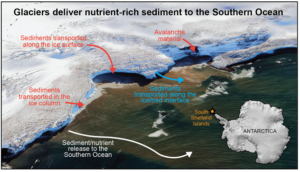
Google Earth image of a glacial system on Livingston Island in the South Shetland Islands, showing how sediment-rich waters (brown colour) emerge from melting ice, delivering essential nutrients to the Southern Ocean.
Low-carbon polar research: Using archived geological samples and satellite data to track Antarctic nutrient flux in a changing climate
Lead Supervisor: Kate Winter (Northumbria University)
This project would be suitable for students with a degree in geology, geoscience, physical geography or a related discipline. An understanding of glaciology is advantageous, but not a requirement.
2708/NZPS/NU/Buzzard

Melting Faster, Modelling Smarter: Emulating Antarctic Ice Shelf Hydrology
Lead Supervisor: Sammie Buzzard (Northumbria University)
This project would be suitable for students with a degree in computer science, physics, mathematics or a closely related subject.
2712/NZPS/NU/Rutter
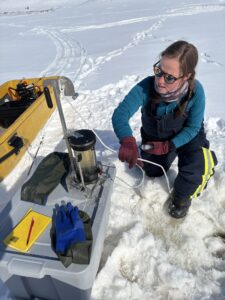
Measuring dissolved carbon dioxide in frozen lake water
Snow, light and life beneath the ice: Understanding winter carbon dynamics in Arctic lakes
Lead Supervisor: Nick Rutter (Northumbria University)
We welcome applications from enthusiastic and motivated students with a degree in physical geography, environmental science, Earth sciences, or closely related quantitative disciplines. Prior experience with fieldwork, data analysis, or environmental instrumentation is helpful, but not essential.
2723/NZPS/NU/Otosaka
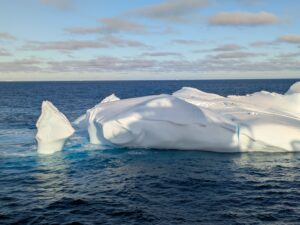
Towards Improved Iceberg Melting Monitoring using Low-Carbon Approaches
Lead Supervisor: Inès Otosaka (Northumbria University)
The successful candidate will have a degree in physics, engineering, Earth Science or a similar numerate subject such as meteorology or oceanography, along with an aptitude and enthusiasm for solving real world problems and computer programming.
2725/NZPS/NU/Banwell
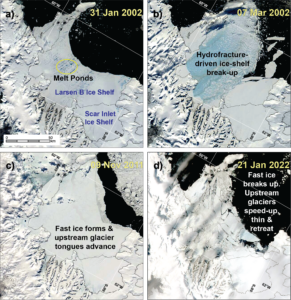
MODIS Terra images of the Larsen B embayment, Antarctic Peninsula
The Role of Landfast Sea Ice in Antarctic Ice Shelf Stability: Integrating Earth Observation with Low-Carbon AI Modelling
Lead Supervisor: Alison Banwell (Northumbria University)
We seek a motivated candidate with strong quantitative and analytical skills, and a degree in Earth sciences, physical geography, environmental science, engineering, applied mathematics, computer science or similar. An interest in glaciology, sea ice and/or climate science is essential. Experience with GIS, Python, Matlab (or similar) and numerical data analysis is desirable, and prior exposure to AI modelling would be advantageous but not required. The student should be enthusiastic about interdisciplinary research and collaborative teamwork.
2742/NZPS/NU/Agarwal
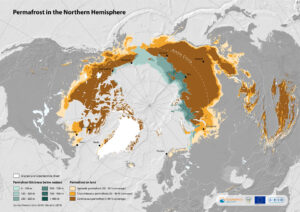
Permafrost subsidence and greenhouse gas release in the Canadian Arctic (Mackenzie Delta): a low-carbon satellite and AI approach
Lead Supervisor: Vivek Agarwal (Northumbria University)
This project would be suitable for students with a degree in remote sensing, geospatial science, environmental or Earth science, physics, geography, engineering, computer/data science, or a closely related subject. A strong quantitative aptitude and interest in programming (e.g. Python or MATLAB) are important, as is enthusiasm for satellite data, climate science and Arctic environments. Prior experience with remote sensing, InSAR, GIS or machine learning is an advantage, but not essential as full training will be provided. We welcome curious, motivated applicants from diverse academic and personal backgrounds.
2750/NZPS/NU/Alex

Mineral Weathering Controls on Arctic CO₂ Budgets: Quantifying the Hidden Permafrost Carbon Source
Lead Supervisor: Aleena Alex (Northumbria University)
This project suits students with a degree in Civil/Environmental Engineering, Geosciences, Chemistry, Material Science, Computational Physics or Chemistry or any related fields. Strong computational and numerical skills – prior programming experience (MATLAB, Python or running MD simulations – LAMMPS) is highly valued. Background in geochemistry, thermodynamics or reaction kinetics is advantageous but not required. The project offers training in kinetic Monte Carlo simulation, geochemical analysis and Arctic field work. Enthusiasm for tackling complex environmental problems using computational approaches is key.
2751/NZPS/NU/Longman
Investigating long-term variability of Antarctic Ice Sheet volume as a driver for volcanic eruptions and their impact on climate: A sustainable approach
Lead Supervisor: Jack Longman (Northumbria University)
This project would fit a numerically strong student with an affinity for coding, and with a knowledge of geology and/or physical geography. The student will have the opportunity to undertake laboratory work as part of the eruption-dating part of the project if they wish. Prior knowledge of volcanology and/or glaciology is an advantage.
2713/NZPS/NU/Wu

Automated dissolved inorganic carbon analysis to reduce travel-related carbon production and improve glacial carbon budget monitoring
Lead Supervisor: Qiang Wu (Northumbria University)
Suitable for students with a degree in Materials Science, Chemical Engineering, Environmental Science or related fields. Candidates should have some experience of nanomaterials and optics, with practical lab skills and enthusiasm for interdisciplinary research in developing advanced sensors.
Lancaster University Projects
2729/NZPS/LU/Miles
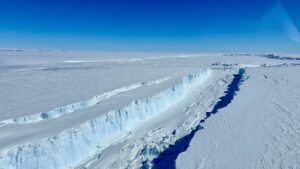
A rift on Shackleton Ice Shelf, East Antarctica, extending towards Denman Glacier
A low-carbon approach to assess Antarctic ice shelf stability and rift processes using multi-frequency satellite radar and ground-based radar archives
Lead Supervisor: Katie Miles (Lancaster University)
The project would be suitable for students with a degree in physical sciences or a closely related subject. Students should be interested in glaciology, remote sensing, and ice shelf rift formation and detection. Experience of working with geospatial data, particularly remote sensing methods, is desirable but not essential. Applicants would normally be expected to hold at least a 2:1 UK Honours degree or equivalent, but experience in relevant fields through non-traditional routes is also encouraged. We welcome applications from candidates from all backgrounds.
2735/NZPS/LU/McMillan

Tracking pan-Arctic ice loss with low-carbon satellite observation
Lead Supervisor: Mal McMillan (Lancaster University)
This project is particularly well-suited to applicants with quantitative skills and a background in mathematics, computer science, physics, data science, engineering, environmental science or geography, who would like to use numeric techniques to study environmental science and climate change.
2745/NZPS/LU/Armstrong
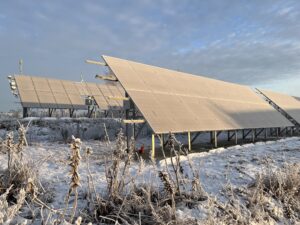
Credit: Erlend Hustad Honningdalsnes, IFE.
Arctic net-zero: assessing solar energy potential and ecosystem consequences
Lead Supervisor: Alona Armstrong (Lancaster University)
This project would be suitable for students with a degree in environment science, geography, ecology, and natural science, or students with a relevant physical science background wishing to apply their skills to this rapidly emerging field. We do not expect applicants to have pre-existing skills across all areas, but the enthusiasm and motivation to develop their skills.
2749/NZPS/LU/Leeson
Thawing Greenland, Powering Tomorrow: Dynamic ice sheet hydrology for Sustainable Energy
Lead Supervisor: Amber Leeson (Lancaster University)
The ideal student will have a background in geography, environmental science, earth sciences, or engineering, with an interest in climate, ice-sheet dynamics, and hydrology. Experience in Python, GIS, or data analysis is desirable, while previous exposure to hydrological modelling would be advantageous but not essential. The student should be enthusiastic about interdisciplinary research, willing to learn new computational and analytical skills, and able to work collaboratively within a research team, including engagement with partners such as Asiaq Greenland Survey.
2752/NZPS/LU/Hossaini
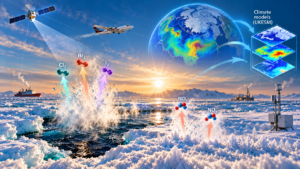
Frozen Frontiers: How Will a Changing Cryosphere Shape Polar Atmospheric Chemistry and Climate?
Lead Supervisor: Ryan Hossaini (Lancaster University)
This project would be well suited to students with an academic background in physics, chemistry, environmental or Earth sciences, or another suitably quantitative discipline. An aptitude for scientific computing and programming would be advantageous, although training will be provided. A strong interest in climate, atmospheric and/or polar science would be particularly valuable. The student should be enthusiastic about interdisciplinary research, keen to develop new quantitative skills, and willing to engage fully with the opportunities provided through co-supervision and collaboration with the British Antarctic Survey.
University of Leeds Projects
2704/NZPS/UoL/Booth
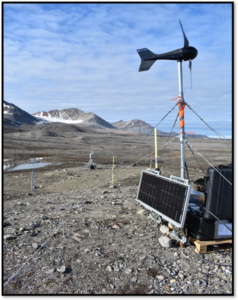
Remote installation of electrical resistivity equipment, monitoring permafrost near to Svalbard's Ny Alesund research village.
Imaging thaw: low-carbon automated geoelectric monitoring of climate warming on permafrost
Lead Supervisor: Adam Booth (University of Leeds)
This project is suitable for students with under/postgraduate experience in a quantitative subject area, for example geophysics, physics, maths, computing, or other cognate discipline. You will be guided in bringing your own ideas to your data analysis. Finally, you should be passionate about environmental science communication and promoting change towards carbon neutral practices.
2702/NZPS/UoL/Craig
Low-carbon monitoring of Southern Ocean temperature variations using earthquake-generated seismic waves
Lead Supervisor: Tim Craig (University of Leeds)
This project would suit a physicist, geophysicist, oceanographer, quantitative Earth scientist or geologist, or mathematician. Candidates will need a strong background in numerical data handling and analysis. Prior skills with coding would be an asset, as would prior experience with either seismic or acoustic data, or physical oceanography, although training in all of these will be provided during the studentship.
2706/NZPS/UoL/Carslaw
Designing atmospheric measurement strategies for optimal gains in climate model reliability
Lead Supervisor: Ken Carslaw (University of Leeds)
The project would be suitable for students with a degree in quantitative STEM subjects like physics, chemistry, mathematics, computer science, operations research, data science, or statistics.
2710/NZPS/UoL/Elliott
Sustainable Balloon Observations of Energetic Particle Impacts on the Polar Atmosphere
Low-Carbon Earth Observation of Arctic Permafrost Thaw and Tundra Fires: Reducing the Carbon Footprint of Big Data Processing
Lead Supervisor: John Elliot (University of Leeds)
This project would be suitable for students with a degree in physical sciences (or a closely related subject). The candidate would need some experience with programming and data analysis as well as an interest in working with large satellite datasets applied to environmental problems in the Arctic.
2726/NZPS/UoL/Maycock
Come rain or snow in a changing climate: predicting future rainfall over Antarctic sea ice using computationally-efficient machine learning
Lead Supervisor: Amanda Maycock (University of Leeds)
This project would be suitable for students with a degree in physics, mathematics, computer science, meteorology, natural sciences, climate science, environmental science or a closely related subject.
2728/NZPS/UoL/Wallis
Understanding glacial sediment plumes and their impact on the cryosphere with a low-carbon satellite data, AI and data mining approach.
Lead Supervisor: Benjamin Wallis (University of Leeds)
This project is suitable for students with an excellent undergraduate or Masters degree in physical sciences, engineering, mathematics, or related disciplines. Experience with programming, including machine learning, AI and geospatial data is highly desirable. Students should have a keen interest in polar science, glaciology, or oceanography, but prior experience of these is not a requirement. We welcome applications from candidates of all backgrounds, including those that are underrepresented in the geosciences. Candidates with work experience outside of academia and non-traditional career paths are encouraged.
2731/NZPS/UoL/Quincey
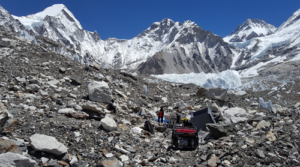
Collecting in-situ measurements of ice temperature on the Khumbu Glacier, Nepal
Seeing More with Less: Quantifying Information Loss in Glacier Monitoring and Developing Low-Carbon Observation Networks
Lead Supervisor: Duncan Quincey (University of Leeds)
This project would be suitable for students with a degree in any environmental discipline, as well as students with skills in computer science, engineering or a related discipline. Experience with quantitative data analysis, programming (e.g. Python, MATLAB) or remote sensing would be advantageous. An understanding of mountain glaciology would also be beneficial but is not essential as the project can be tailored towards the specific skill-set of the student, providing the outputs of the project remain relevant for observing the mountain glaciology environment.
2733/NZPS/UoL/Tarn
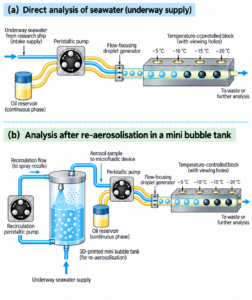
Schematic showing the concept of the “Microlitre Lab-on-a-Chip Nucleation by Immersed Particle Instrument” (µLOC-NIPI) and miniaturised bubble platforms for continuous flow ship-based seawater INP analysis.
Low-carbon continuous monitoring of ice-nucleating particles in polar seawater and sea spray
Lead Supervisor: Mark Tarn (University of Leeds)
This project would be suitable for students with a degree in a relevant environmental science or physical science discipline (e.g. chemistry, physics, engineering), or a closely related subject.
2741/NZPS/UoL/Arnold
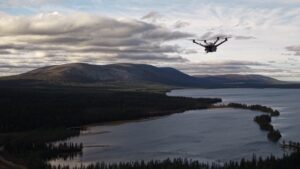
Designing an Optimal Low-carbon Arctic Atmospheric Observing Network Through Intelligent Sampling and Model-Observation Synthesis
Lead Supervisor: Steve Arnold (University of Leeds)
The project would be suitable for students with a degree in a numerate subject, including chemistry, physics, maths, engineering or an environmental degree such as Environmental Science, Geophysics or Earth system science, or other related subjects.
2744/NZPS/UoL/Regayre
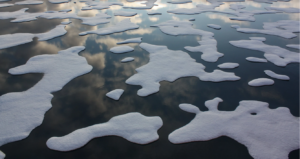
Leighton Regayre. Closing the gaps in Arctic climate projections (Credit NASA)
Disentangling Local and Remote Sources of Arctic Aerosol
Lead Supervisor: Leighton Regayre (University of Leeds)
This project would be suitable for students with a degree in atmospheric science, climate science, environmental science, physics, mathematics, statistics, computer science or a closely related subject. A strong quantitative background and enthusiasm for learning new computational methods are more important than prior expertise in aerosols or climate modelling. The project combines physical science, data science and environmental observations, offering training in climate modelling, high-performance computing, statistics and machine learning. Motivated students from diverse STEM backgrounds who are excited by interdisciplinary research and tackling important climate challenges are particularly encouraged to apply.
2747/NZPS/UoL/Surawy-Stepney

From cracks to continents: Resource-efficient modelling Antarctic ice shelf viability with damage mechanics
Lead Supervisor: Trystan Surawy-Stepney (University of Leeds)
Suitable for ambitious, mathematically-minded students with a good undergraduate or Master’s degree in physics, mathematics, or engineering. Experience with general-purpose programming (Python, C, Julia, etc) would be valued but is not required. An enthusiasm for and aptitude in maths and physics is essential.
2748/NZPS/UoL/Hogg
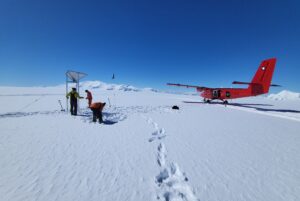
How fast?: Low carbon measurements of ice speed change on the Greenland Ice Sheet, and their drivers
Lead Supervisor: Anna Hogg (University of Leeds)
Applicants will hold good first degree (first or high 2.1) or Masters degree in physics, maths, Earth science, climate science, computer science, Earth observation or a related discipline. We welcome applications from a wide range of backgrounds, including those with non-traditional qualifications or from industry – please contact us to have a chat about your suitability for the programme.
University of Reading Projects
2705/NZPS/UoR/Feltham
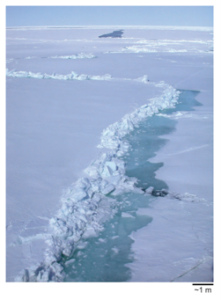
Pressure ridge northwest of Alaska, June 2002. Approximately 3 m wide and formed from ice less than 1 m thick.
Machine learning enhanced sea-ice dynamics for climate modelling
Lead Supervisor: Daniel Feltham (University of Reading)
The successful candidate will have a degree in physics, applied mathematics, computer science, engineering, or a similar numerate subject such as meteorology, along with an aptitude and enthusiasm for solving real world problems and computer programming. The candidate should be able to work independently and in groups and be enthusiastic. While knowledge of the climate system, oceanography, sea ice, or meteorology would be ideal, this knowledge can be taught to the right candidate.
2711/NZPS/UoR/Koppa
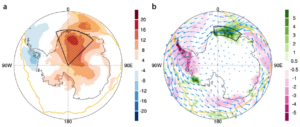
2m temperature (a) and precipitation (b) anomalies during the July 24 – August 9, 2024 mega heatwave in East Antarctica. The anomalies are computed relative to the 1981–2010 climatology. The black box in (a) indicates the Dronning Maud Land and in (b) indicates the region with region with the most intense precipitation (adapted from Tang et al. 2026).
Unravelling the origins of compound polar hot and wet extreme events through carbon-efficient emulation of atmospheric heat and moisture transport
Lead Supervisor: Akash Koppa (University of Reading)
This project would be suitable for students with a degree in meteorology, physics, mathematics, environmental science, computer science, or a closely related quantitative subject. Programming experience, ideally in Python, is desirable. Prior exposure to machine learning, atmospheric modelling, or high-performance computing is an advantage: full training will be provided in all three. Above all, the project suits a student curious about extreme weather and motivated to make climate science in polar regions sustainable.
2724/NZPS/UoR/Schroeder
Explore extremely-low-resolution climate modelling to improve Arctic and Southern Ocean projections of sea ice
Lead Supervisor: David Schroeder (University of Reading)
The successful candidate will have a degree in physics, applied mathematics, computer science, engineering, or a similar numerate subject such as meteorology, along with an aptitude and enthusiasm for solving real world problems and computer programming. The candidate should be able to work independently and in groups and be enthusiastic. While knowledge of the climate system, oceanography, sea ice, or meteorology would be ideal, this knowledge can be taught to the right candidate.
2730/NZPS/UoR/Gray
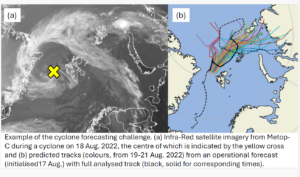
Machine Learning for predicting hazardous Arctic storms
Lead Supervisor: Suzanne Gray (University of Reading)
This project would be best suited to a student with a strong physical sciences or mathematical background. The student will not need to have prior coding or data analysis expertise as full training and support will be given, but they should be keen to perform careful analysis of the outputs of complex weather forecast models.
2732/NZPS/UoR/Nicoll
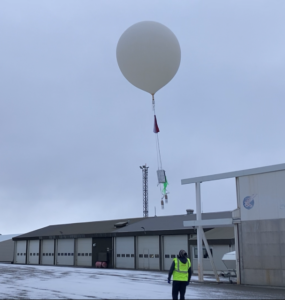
Sustainable Balloon Observations of Energetic Particle Impacts on the Polar Atmosphere
Sustainable Balloon Observations of Energetic Particle Impacts on the Polar Atmosphere
Lead Supervisor: Keri Nicoll (University of Reading)
This project would be suitable for students with a background in physics, engineering, chemistry, atmospheric sciences or a closely related subject. The project will involve practical work in the laboratory and field, so previous experience of this is desirable, as is some knowledge of electronics (but this is not essential).
2737/NZPS/UoR/Quaife
Solar Induced Fluorescence for Tracking Arctic Greening and the Increased Uptake of Carbon, using a Climate Aware Compute Resource
Lead Supervisor: Tristan Quaife (University of Reading)
This project would be suitable for students with a degree in physics or computer science, with an interest in applying their skills to environmental problems, or students with degrees in geography or biology who have excellent quantitative and programming skills.
2739/NZPS/UoR/Shahgedanova
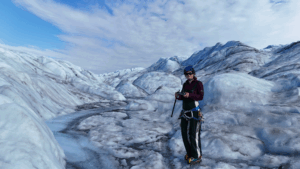
The Third Pole Net Zero: Cryosphere Change and Small Hydropower
Lead Supervisor: Maria Shahgedanova (University of Reading)
This project is suitable for students with a degree in an environmental discipline, as well as chemistry, physics, engineering or a related subject. Experience in laboratory work, quantitative data analysis and programming (e.g. R, MATLAB, Python and Java) would be advantageous. Knowledge of mountain climate, glaciology and hydrology would be beneficial but is not essential. The student should be willing to undertake fieldwork in remote mountain environments, work effectively with people from different cultural backgrounds, and be enthusiastic about interdisciplinary research.
British Antarctic Survey Projects
2719/NZPS/BAS/MartinGarcia
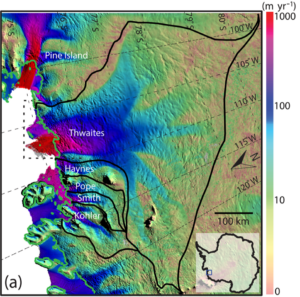
How does viscous anisotropy affect ice sheet dynamics and sea-level rise? Combining modelling and remote sensing
Lead Supervisor: Carlos Martin Garcia (British Antarctic Survey)
This project would be suitable for students with a degree in mathematics, physics, engineering, geoscience, computer science or a closely related subject. Students are expected to have a high level of numeracy, ability to code, and interest in working in an interdisciplinary environment developing green skills.
2721/NZPS/BAS/Jordan
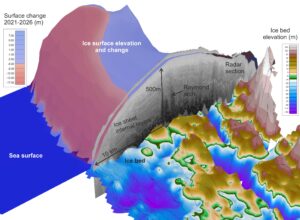
3D visualization of Adelaide ice cap, including satellite derived surface elevation change, airborne radar section and associated sub-ice topography.
Assessment of rapid change on Adelaide Island; will low emission surveying solutions allow us to better understand the evolution of the Antarctic Peninsula in a warming world?
Lead Supervisor: Tom Jordan (British Antarctic Survey)
This project would be suitable for students with a degree in geology, geoscience, physical geography or a related discipline. An understanding of glaciology is advantageous, but not a requirement.
2727/NZPS/BAS/Manno
Low-carbon ocean intelligence: tracking zooplankton-driven carbon export with autonomous technology
Lead Supervisor: Clara Manno (British Antarctic Survey)
This project would suit a student with a background and interest in marine or environmental science/ environmental engineering/ environmental statistics. The student should have experience/ interest in numerical modelling and the practical development and application of marine autonomous observational systems.